

















I put a provocative question to an AI model: “Can businesses build their own CRM in-house by 2029?”
The answer was more nuanced than I expected. Technically, yes. Strategically? That’s a different conversation.
The AI itself flagged three risks that most enterprises underestimate when they consider going it alone:
- Security, privacy & compliance risk shifts from vendor to client. The moment you build in-house, you inherit the regulatory burden that a specialist vendor previously carried for you.
- Hidden costs erode the “we’ll save money” assumption. Testing, monitoring, upgrades, incident response, and maintaining AI-generated code all add up. In-house teams rarely achieve the economies of scale a dedicated CRM provider can.
- Customer intelligence can’t be reconstructed overnight. AI can write code. It cannot instantly recreate years of loyalty expertise, industry pattern recognition, and hard-won customer insight.
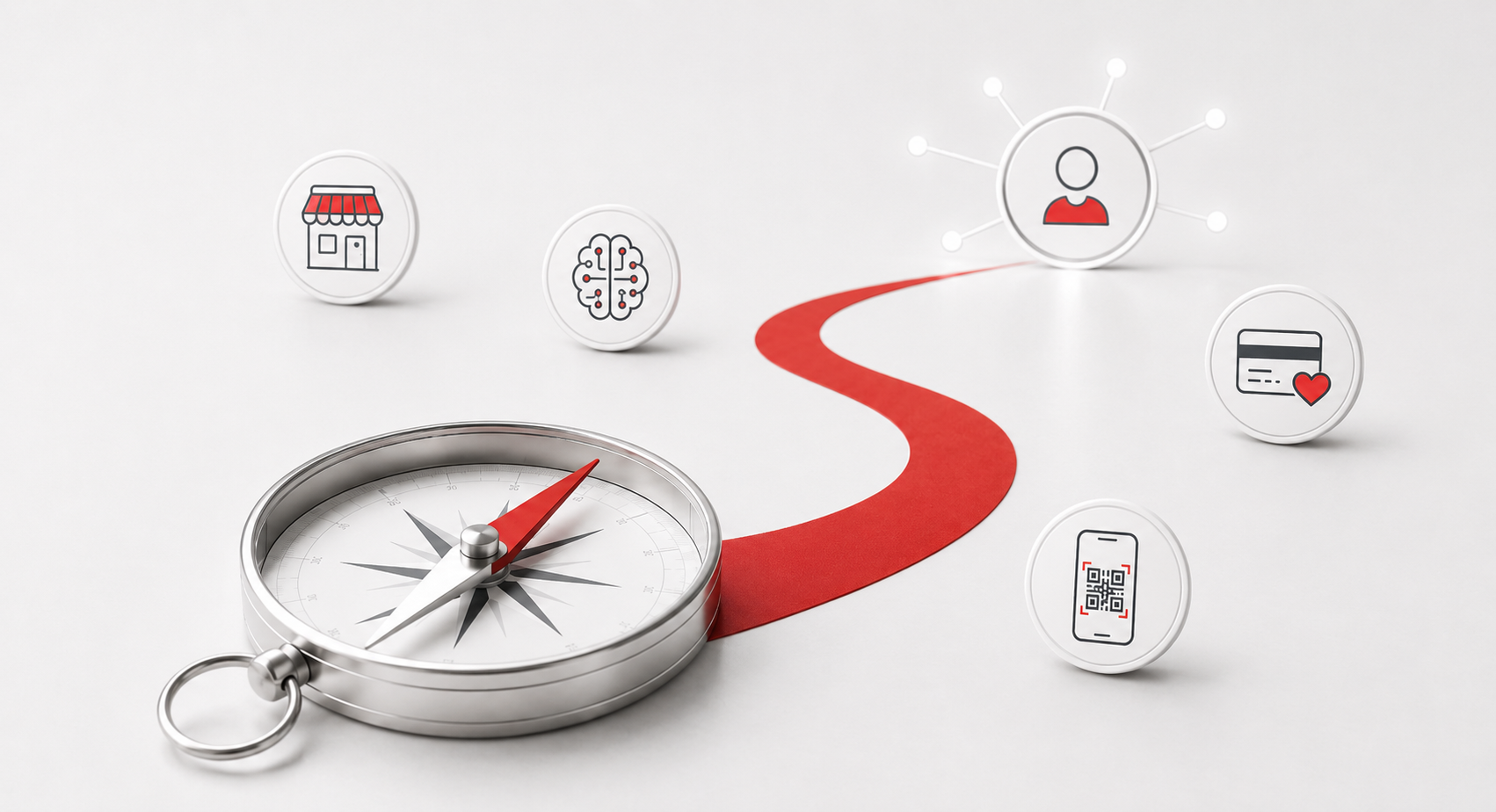
The takeaway: CRM strategy needs to be rethought now, not in three years. What CRM looks like today will bear little resemblance to what it looks like tomorrow. The shift is being driven by four converging trends.
Trend #1: Traditional CRM → Autonomous CRM
Today’s CRM is UI-led. It depends on specialists with deep domain knowledge to operate it, and on humans to interpret the data it produces.
That model is being replaced by a conversational, decision-led infrastructure
happening on a single interface where multiple AI agents handle the operational heavy lifting: analyzing information, configuring workflows, surfacing decisions. Humans shift from operators to validators.
Enterprises that move early from “platform to operate” to “infrastructure to decide” will set the pace their competitors are forced to follow.
Trend #2: Payment and Loyalty Are Converging
Right now, a typical retail flow still juggles between POS, router, OCR box, data capture terminal, printer, barcode scanner, PIN pad and payment terminal. Therein lies a disconnect from loyalty.
Agentic payment changes that. Promotion and recommendation logic moves out of the POS and into the CRM itself. The Unified Payment Gateway becomes a Unified Payment Loyalty Gateway (UPLG), with natural-language-to-API (NL2API) capability replacing raw data analysis with real information analysis.
Payment and loyalty are no longer two systems that talk to each other. They’re becoming one system that thinks.
Trend #3: App-Less Loyalty
Loyalty apps are losing their shiny appeal. App fatigue (yet another download, another login), fixed and costly-to-change UIs, and the ongoing burden of store approvals, OS updates, and security testing are pushing customers and enterprises away.
The replacement: Google Pass and Apple Pass, joined via QR code, WhatsApp, SMS, or web. No download required. Conversational AI replaces navigation. Maintenance cost drops because there’s no app to redeploy.
The enterprises still investing in native loyalty apps are optimizing for a channel that’s already being phased out by their own customers’ behaviour.
Trend #4: CRM Transitions to CIP
This is the trend that reframes everything above it.
CRM tells you what happened. A Customer Intelligence Platform (CIP) tells you why it happened and what to do next.
CIP unifies CDP, membership profiles, transactions, behaviour, campaigns, rewards, payments, and support cases into one continuously updated view of the customer. It turns that unified data into predictions and decisions, then orchestrates a consistent next-best action across every channel – AI agents, wallets, WhatsApp, web, and POS in real time.
CRM was built to record the relationship. CIP is built to run it.
The Real Question Isn’t “Build or Buy”. It’s “Are You Ready for What Comes Next?”
These four trends aren’t isolated. They’re converging into a single reality: CRM is becoming a multi-agentic ecosystem that behaves, thinks and reacts differently from anything enterprises have operated before.
Building that in-house isn’t impossible. But the risks outlined around compliance exposure, hidden AI-maintenance costs, and an underdeveloped customer intelligence layer are exactly where most in-house builds stagnate.
Ascentis been designing for this shift directly.
If your team is rethinking its CRM roadmap for the next three years, this is the conversation worth having now. Reach out to our team and let’s talk about where your CRM strategy needs to go next.
